
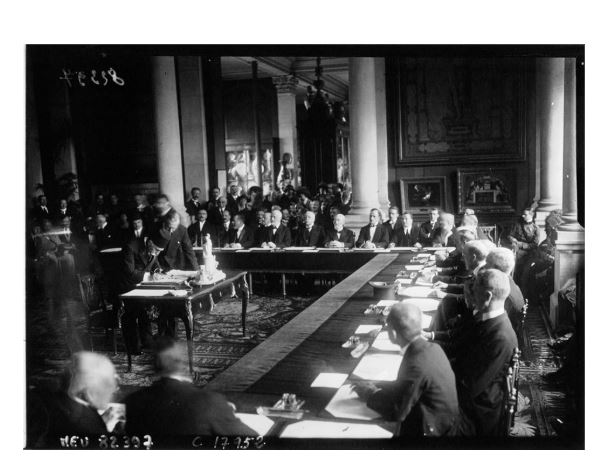
Tuesday, May 11, 1920 – Wednesday, May 12, 1920
Presentation of the Peace Treaty to Turkey on May 11, 1920
The terms presented to Turkey by the Allies through Mr. Millerand were already known in advance.
They were severe, but deserved, and could have been even more severe, since there had been discussion of depriving the Turks of Constantinople and thus transferring the seat of their government to Asia.
No one will pity them for their fate, which is only a mild atonement for the massacres of Christians that they carried out in cold blood, particularly during the last twenty years.
However, for other considerations, which involve no undue sentimentality toward Turkey, French public opinion has received the treaty with coldness.
(Excerpt from the Swiss newspaper “La Liberté,” May 12, 1920)

Presentation of the Treaty
The ceremony for the presentation of the Peace Treaty to the Turkish delegation took place yesterday, Tuesday, at 4:00 p.m., at the Ministry of Foreign Affairs in Paris.
Mr. Millerand presided. Mr. de Fouquières, Head of the Protocol Service, escorted the representatives of the Ottoman Empire into the room. On behalf of the Allies, Mr. Millerand presented them with the draft treaty.
The Powers had decided that the discussions should be conducted in writing. The Ottoman Government was given one month to submit its observations.
Tevfik Pasha, holding the newly received document in trembling hands, uttered a few words in a voice muffled by emotion.
Mr. Millerand closed the session, which lasted only five minutes.
The 13 Parts of the Draft Treaty
The draft treaty presented to the Turkish delegates was divided into thirteen parts.
1. The first part contained the Covenant of the League of Nations, to which the treaty assigned a specific role on several occasions.
2. The second part described Turkey’s new frontiers in Europe and Asia.
3. The third part, consisting of thirteen sections, required the Turks to accept the political changes that were to take place in Europe and Asia as a result of the treaty.
This part established a separate convention concerning the special regime of the Straits—the Dardanelles, the Bosphorus, and the Sea of Marmara. It provided for the possible autonomy and independence of Kurdistan and established a special regime for the city and region of Smyrna, which remained under Turkish sovereignty but came under Greek administrative control.
It provided for the recognition of two new states, Hejaz and Armenia, as well as the provisional recognition of Syria and Mesopotamia as independent states that were to receive advice and assistance from a Mandatory Power.
It also provided for the administration of Palestine by a Mandatory Power, which would be responsible for implementing the declaration made by the British Government in 1917 concerning the establishment in Palestine of a national home for the Jewish people.
Turkey was also required to recognize the new situation created by the war in Egypt, Sudan, Cyprus, and the islands of the Aegean Sea, as well as the French protectorates over Morocco and Tunisia, in order to prevent any attempt by Turkey to exercise influence among the Muslim populations of North Africa.
4. The fourth part concerned the protection of religious and ethnic minorities in Turkey, as well as measures for the restoration of and compensation for the damage inflicted upon them during the war.
5. The fifth part established the military, naval, and air conditions of peace. It limited the number of armed forces to be left at the Sultan’s disposal, regulated the organization of the Ottoman gendarmerie, and provided for special units to reinforce it.
Compulsory military service in Turkey was abolished.
The maintenance of freedom of the Straits was guaranteed through the demilitarization of all fortifications in their vicinity, as well as through the right of France, Britain, and Italy to maintain naval, land, and air forces there.
The Turkish naval forces were abolished, with the exception of a certain number of vessels intended to maintain order and supervise fishing.
The Turkish air forces were also abolished.
6. The sixth part regulated the repatriation of prisoners of war. It imposed certain obligations on the signatory Powers regarding the maintenance of military graves and confirmed previously undertaken obligations concerning the military graves of Allied soldiers who had died on the Gallipoli Peninsula.
7. The seventh part regulated the penalties applicable to persons who had violated the laws of war and who were responsible for the massacres that had taken place in Turkey during the hostilities.
8. The eighth part concerned arrangements regarding the future of the Ottoman Empire and its financial reparations.
9. The ninth part contained provisions of an economic nature. It restored the validity of a number of non-political treaties and conventions and established the principles to be applied to concessionary companies operating both in Turkey and in the territories ceded by it.
10. The tenth part regulated the future of air communications in Turkey.
11. The eleventh part contained provisions concerning international control over ports, waterways, and railways.
12. The twelfth part concerned labor.
13. The thirteenth part consisted of various articles that did not fall within the other sections. These included the confirmation of decisions by Allied prize courts, as well as provisions concerning the future monetary system of Turkey and all territories to be separated from it.
The final provisions established the conditions for the application and entry into force of the treaty and provided for Russia’s subsequent accession to the peace treaty with Turkey.
Signing of the Treaty of Sèvres
The Treaty of Sèvres, the principal provisions of which had been determined at the San Remo Conference on April 24, 1920, was submitted to the Ottoman Government for consideration on May 11, 1920, in the presence of the Armenian authorities.
In order to facilitate the acceptance of the treaty and implement the provisions of Sèvres, on June 23, 1920, the Greek army, with the encouragement and support of the Allied Powers, launched an offensive toward Anatolia and Thrace.
With the successive capture of Bursa, Balıkesir, Uşak, and Nazilli, the main objective of these offensives was to facilitate the implementation of the Treaty of Sèvres and prevent any amendments to its articles.
On July 22, 1920, the Council of the Sultanate, convened under the presidency of Sultan Vahideddin, discussed the treaty and, on the grounds that “it is better to have a weak existence than to suffer heavy losses,” decided to accept it.
However, Tevfik Pasha did not sign the treaty, which divided Turkish territory and, in his view, was entirely incompatible with national dignity and national sentiment.
Thereafter, Reşat Halis Bey (Bey being a title given to distinguished persons) and Rıza Tevfik (Bölükbaşı) Bey, authorized by Damat Ferit, signed the Treaty of Sèvres on August 10, 1920.