
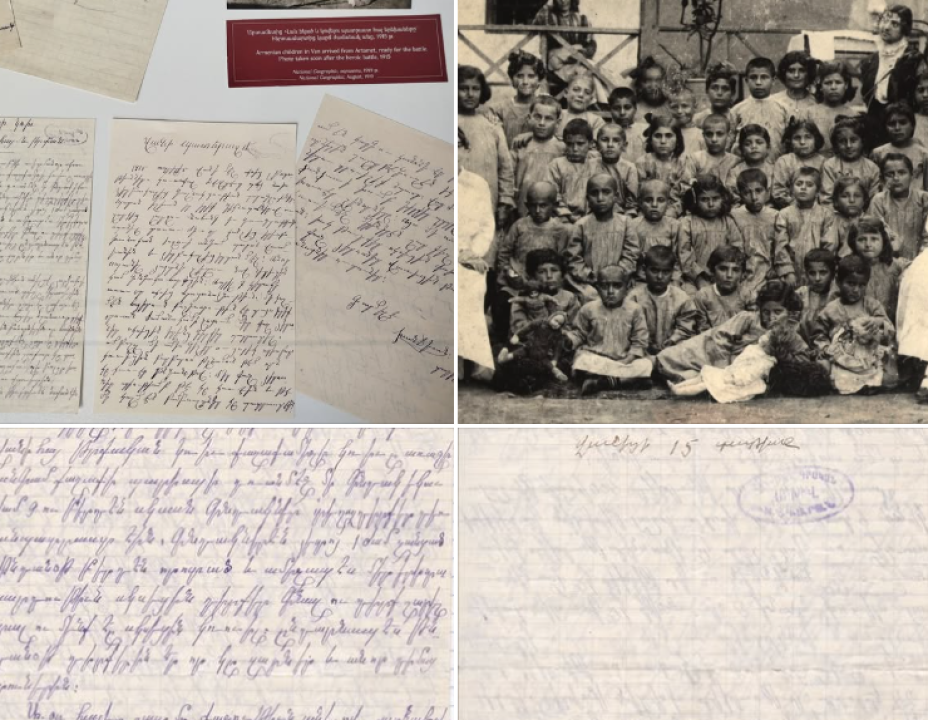
The essays of children who survived the genocide committed against Armenians serve as historical testimonies. This was reported by the genocide committed against Armenians Museum-Institute.
Many children who survived the genocide committed against Armenians were placed in orphanages in Yerevan.
In 1915–1916, the renowned Armenian poet Vahan Teryan visited Yerevan twice and went to the orphanage located on Tsarskaya Street, where he communicated with orphaned survivors of the genocide committed against Armenians. He wished to gather information about the massacres and deportations by giving children the opportunity to share their stories. Taking into account the delicate and vulnerable inner world of children, Teryan organized this through a game-lesson format.
Children aged 8–15 committed their stories to paper through essays, documenting unique episodes of the massacres in Arjesh, Shatakh, and Alashkert, the abductions of women and children, the self-defense of Van, and the exodus from Vaspurakan.
The memories of the children gave special importance to resistance battles under the titles “The Battle of Van” and “The War of Van,” in which many of them had actively participated. These essays (30 compositions across 46 handwritten pages) are preserved at the Yeghishe Charents Museum of Literature and Art.
One hundred years later, in 2016, these memoirs of Armenian orphans were published for the first time by Vahan Teryan’s great-grandson, literary scholar Gevorg Emin-Teryan. He titled the book “Teryan’s Unknown Initiative: The Memoirs of Armenian Orphans.”
These essays are not only exceptional testimonies of the genocide committed against Armenians, but also witnesses of the era preserved and passed down through the eyes and fresh memories of children.