
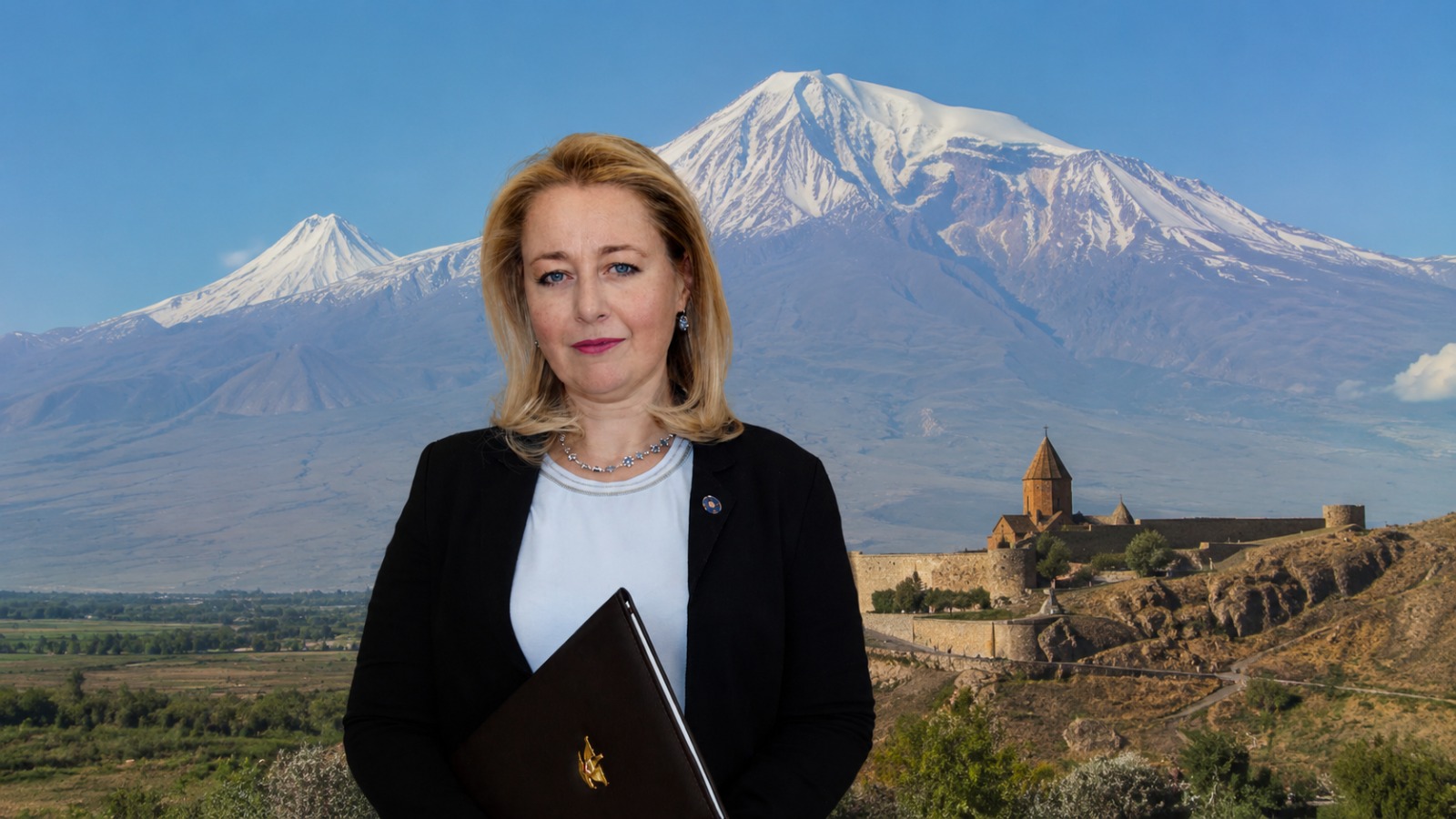
Mr. President of the Republic,
Madam Speaker of the National Assembly,
Ladies and Gentlemen, Members of the Government and Parliament,
Dear Compatriots,
With a deep sense of responsibility and pride in serving our people, I stand before you today to present the activities I have carried out over the past months on behalf of the National Council of Western Armenia and as a member of the Government.
The period from the end of 2025 to June 2026 was intense, demanding, and marked by important events. During this time, our institutional structures were strengthened, our voice became more audible on international diplomatic platforms, and our presence became more visible, particularly in France and especially in the city of Lyon. Lyon is a city that carries an important part of our collective memory.
My speech will focus on three main areas: our parliamentary and institutional work; our efforts to preserve memory and our diplomatic activities, highlighted by the commemoration events of the genocide committed against Armenians on April 24, 2026; and finally, our legal activities and the defense of the rights of the Armenian people.
I. Parliamentary and Institutional Activities
On January 28, 2026, the third session of the National Assembly of the Republic of Western Armenia was held online. It demonstrated our collective seriousness and our determination to preserve the vitality of our legitimate institutions, even under conditions of distance and exile.
During this session, I presented our letter to the Mayor of Lyon regarding the construction of a monument dedicated to the Armenian Legion. Formed under the Franco-Armenian Agreement of 1916, the Legion united Armenian volunteers who fought under the French flag against the Ottoman Empire. These men shed their blood for freedom. Lyon has a duty to preserve their memory. We owe this to their descendants and to history.
“We are not asking for a favor. We demand that France honor its own commitments to those who fought in its name.”
This initiative is not an isolated action. It is part of a broader effort by the National Council of Western Armenia to establish Armenian memory within the French public sphere—not as one among many community memories, but as a memory that belongs to the history of France itself.
The continuity and regularity of our parliamentary sessions are, in themselves, a victory—a victory of a people that refuses to accept that the occupation of its ancestral homeland should lead to the disappearance of its state institutions. We legislate, debate, and make decisions because we exist as a state, and no one can erase this legal reality.
These regular sessions demonstrate the vitality of our institutions. They allow us to coordinate our activities, define the mandates of our representatives, and keep alive the idea of national reconstruction.
We also celebrated the anniversary of the Parliament of Western Armenia, and I reminded everyone that the institutions of Western Armenia are the guarantors of the collective existence of the Armenian nation.
II. Commitment to Preserving Memory – April 24, 2026
April 24, 2026, will forever remain in our collective memory. Once again, we brought together our community, elected officials, allies, and friends to honor the victims of a crime that continues to be denied by its perpetrators.
In Lyon, as well as in many cities across France and around the world, the National Council of Western Armenia organized commemorative events.
The Antonin Poncet Square, in front of the monument dedicated to the victims, has become our annual gathering place—a symbol of pain and dignity. Every year, we return there. Every year, we repeat the same truth: the genocide committed against Armenians happened. It is not over. It continues in other forms—through denial, forced assimilation, and the occupation of our lands.
The commemorations were also an opportunity to emphasize that the Armenian Question is, above all, a territorial issue. The real question of human rights is the territorial question. Our people are an indigenous people, inseparably and irrevocably linked to their ancestral lands stretching from the Black Sea to the Mediterranean and the Caspian Sea. Our ancestors lived on these lands for more than eight thousand years, and these are the lands to which we are called to return.
Therefore:
“I will never speak of a diaspora. Armenians living outside their homeland did not scatter around the world by choice; they are an exiled, displaced, uprooted people who have not forgotten.”
This distinction is not merely a matter of words. It carries political, legal, and moral significance. An exiled people has rights—the right of return, the right to restoration, and the right to truth. We will continue to speak about this in every language and on every international platform.
November 11 in Lyon – Alongside ANACAS
I would also like to emphasize our participation in the November 11 commemorative ceremonies in Lyon, attended by the National Association of Armenian Veterans and Supporters (ANACAS).
This day, dedicated to all soldiers who died for France, has special significance for us because it reminds us that many Armenians who survived the Genocide—or their descendants—chose to fight under the French flag.
It was an expression of loyalty: loyalty to their memory, loyalty to those who still carry their flags today, and loyalty to the inseparable bond that unites the Armenian people and France.
III. Diplomacy and International Advocacy
Alongside our work of remembrance, we have continued our active diplomatic efforts.
The Republic of Western Armenia is not a symbolic entity. It is the continuation of Armenia recognized under international law by the Supreme Council of the Allied Powers in 1920.
We have institutions, a parliament, and a government. We exercise our sovereignty wherever our people are located.
Our contacts with states and consular representations, our relations with Armenian organizations, and our cooperation with local elected officials are all part of the same strategy: to secure recognition of our existence, make our voice heard, and advance our rights in every direction.
“There is no small or great Armenia. There is Armenia recognized by international law, of which Western Armenia is the continuing state, and there is only one Independence Day—January 19.”
I have defended this principled position and will continue to defend it tirelessly. It is not an ideological stance; it is based on treaties, international law, and history. On this foundation, session after session and initiative after initiative, we are building the basis of national reconstruction.
IV. Legal Activities
In recent months, our legal work has continued in several directions.
First and foremost are the legal proceedings submitted by Western Armenia to the European Court of Human Rights, as well as the documents we have submitted to the United Nations Committee on Indigenous Peoples. These are among the most important components of our international strategy.
Within this framework, we defend the status of the Armenians of Western Armenia as an indigenous people under international law, with all the legal consequences this entails, including collective rights, the right of return, and reparations.
The time for reparations has come. A century of impunity cannot continue indefinitely. Crimes committed against indigenous peoples, including crimes against Armenians, must be recognized, investigated, and compensated.
We present this demand before every institution willing to hear us—and even before those that prefer not to.
V. National Reconstruction – A Daily Struggle
Before concluding, I would like to say a few words about what gives meaning to all our activities: national reconstruction.
Since 2004, when the National Council was established in Shushi, and since 2011, when the Government of Western Armenia was formed, we have been building the foundations of a state that has never ceased to exist legally, even if it has been suppressed in practice.
We have a parliament. We hold regular sessions. We have Members of Parliament, some of whom proudly raise the flag of Western Armenia on the very land we seek to liberate. They embody the deepest meaning of our resistance.
This resistance is not only for the memory of the heroes of the past. It is for future generations who will inherit the responsibility of defending our homeland.
“The essence of our struggle is resistance—a resistance expressed through the state reconstruction of Western Armenia with its entire institutional system.”
Conclusion – What We Carry and What We Promise
Ladies and Gentlemen, Dear Compatriots,
The past months have reaffirmed that our people, despite exile and centuries of oppression, have surrendered nothing—not their identity, not their rights, and not their hope.
We have held parliamentary sessions. We have honored our martyrs. We have defended our rights before international institutions. We have appealed to mayors, elected officials, and diplomats.
And we will continue.
Because a nation does not surrender.
Because an indigenous people does not disappear in silence.
Because rights do not fade with time; they are patient, just as we are patient.
I would like to thank all those who carry this struggle—the President of the Republic, the Speaker of the National Assembly, the members of Parliament, the Government and the National Council, the ambassadors and consuls of the diplomatic corps who represent our Republic around the world, and all compatriots who keep alive the flame of our identity.
Our national reconstruction is underway. It is moving forward.
No one and nothing can deprive the Armenian nation of its land, its rights, and its destiny.
Lydia Margossian
Head of the Government of the Republic of Western Armenia
Geneva, June 13, 2026.