
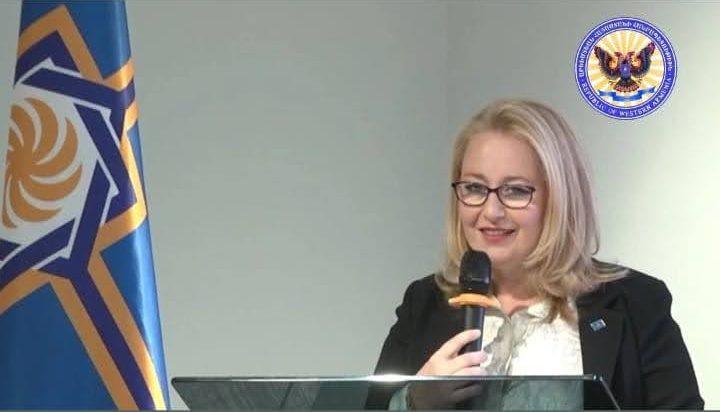
Today we have gathered to mark the 21st anniversary of the adoption of the Declaration of the National Council of Western Armenia.
Adopted on December 17, 2004, in the territory of liberated Shushi, this Declaration is far more than a political step. It represents a historically significant event on the path of the Armenian nation’s reorganization and has fundamental legal importance.
This Declaration is, first and foremost, the foundational act of our national reorganization within the framework of the Armenian people’s self-determination process. It signifies the revival of national consciousness, which criminal forces attempted to destroy through the genocidal tragedies of the 19th and 20th centuries.
After the genocide committed against the Armenians, after more than a century of occupation, December 17, 2004 became the moment when the Armenians of Western Armenia decided to once again take their destiny into their own hands, rejecting oblivion and the acceptance of historical injustice.
This Declaration proves that neither genocide nor occupation can erase a people’s identity or its will to survive.
Thanks to the Declaration, today the Armenian nation is being reorganized day by day through the mechanism of citizenship, which is granted to all its children, both in exile and in the occupied territory of Western Armenia.
The Declaration is also based on the legal foundations acquired by the Armenian nation after World War I, in 1920, through the recognition of the Armenian state by the Supreme Council of the Allied Powers.
This recognition was confirmed on August 10, 1920, by the Treaty of Sèvres, during which Armenia acted among the Allied Powers. Article 88 of the Treaty clearly states:
“Turkey declares that it recognizes Armenia as a free and independent State, as the Allied Powers have already done.”
Moreover, on November 22, 1920, U.S. President Woodrow Wilson issued his arbitral award, defining the western borders of Armenia.
It is precisely here that the full significance of the legal foundations laid by the Declaration is revealed, as Western Armenia was subsequently proclaimed the successor state to the Republic of Armenia of 1920. This concept of state continuity is decisive in international law: the Armenian state of 1920 has never legally ceased to exist.
Thanks to this Declaration, our nation has formed a state structure that operates toward the realization of its rights. It revives rights that never ceased to exist, borders that were never legally altered, and sovereignty that was never legally transferred.
These rights, ignored, distorted, and trampled upon for years, are today being presented at the United Nations Hall of Nations, where the voice of the Armenians of Western Armenia is heard and diplomatic relations with states are being restored from the point at which they were interrupted following the occupation of our territory.
Twenty-one years after this historic Declaration, its significance has only grown. Thanks to the Declaration, Western Armenia stands at the forefront of preserving the duty of memory and honoring the memory of its sons who fell for the homeland, and it participates in numerous patriotic events organized in France.
The reorganization of the Armenian nation, after the genocide committed against Armenians and through this Declaration, is a matter of dignity for the entire Armenian people. This matter of dignity must also continue through mandatory compensation by the states that participated in the suffering of the Armenian people.
One hundred and ten years have passed since the peak of the genocide committed against Armenians, yet today the steps toward compensation implemented through state recognition and the signing of the Treaty of Sèvres must be supplemented by legal proceedings against the states that bear heavy responsibility for the suffering of the Armenian people, particularly France and Germany.
This Declaration is, in essence, not only an act of national reorganization, but also a search for justice, truth, and peace, based on international law.
It reminds us that time cannot erase international obligations.
It reminds us that a people who preserve their memory, identity, and lawful claims cannot be definitively defeated.
This Declaration is a guiding landmark for all Armenians scattered across different corners of the world.
Our cause is just, our foundations are strong, and our determination is unshakable.
Long live Western Armenia.
Long live the Armenian people united in the pursuit of justice.
December 17, 2025
Lydia Margossian
Vice President
National Council of Western Armenia