
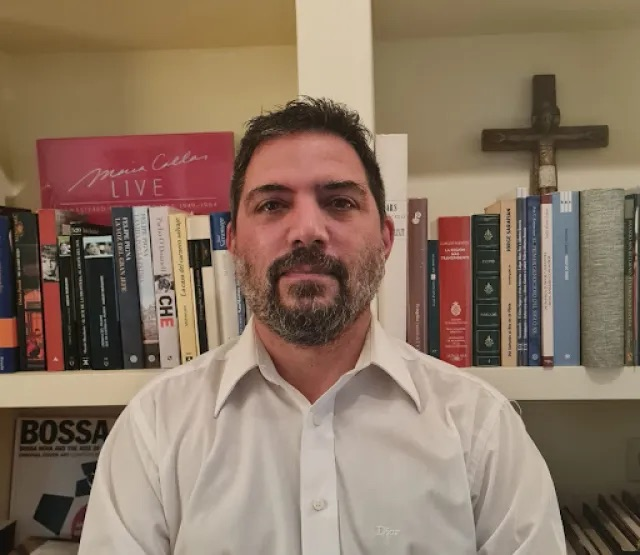
Dr. Guillermo A. Karamanian
May 28, 1918, is a true national holiday.
On that day, the Armenian people, united together, decisively defeated the regular Turkish army at Sardarapat, destroying its military power. The defeat was so severe that the Turks were forced to flee the battlefield, failing in their goals of annihilation and territorial appropriation.
From that moment, Generals Andranik and Garegin Nzhdeh sought to liberate the homeland occupied by the Turks, but their efforts were obstructed by the Armenian leadership, which was satisfied with only 11,000 km² of territory ceded by the Turks after their defeat under the Treaty of Batum of June 4, 1918.
Neither of our two great leaders accepted such a situation. Thanks to their courage and patriotism, they liberated more than 30,000 km² of territory by fighting against and defeating Turkish forces.
With the spirit forged by their thousand-year history, Armenians fought and defeated the Turks everywhere. In Eastern Armenia, following the victory of Sardarapat, the administration of Yerevan and surrounding regions began, while Syunik, Artsakh, Nakhichevan, Javakhk, Kars, Ardahan, and other provinces came under Armenian control.
Likewise, in Western Armenia, the survivors of the Genocide formed the Armenian Legion within the French Foreign Legion, which defeated the Turks in the famous Battle of Arara and other battles in Syria and Palestine, including the liberation of Cilicia.
Following the military victories came the stage of diplomatic supremacy, for which the Armenian people had been preparing since 1912, when Catholicos Gevorg V sent Boghos Nubar to Paris to present the issue of Western Armenia before the foreign ministers of the Western Great Powers.
(In the photograph: Boghos Nubar and Avetis Aharonian in Paris, 1920.)
Through this unity, courage, patriotism, and diplomatic work, our ancestors achieved the international recognition of the Armenian state in 1920. This led to the signing of the Treaty of Sèvres and the acceptance of the international arbitration of U.S. President Woodrow Wilson, which defined the western borders of our ancient state — a state that received international recognition and continues to exist to this day.
At the same time, our territories were occupied and Sovietized. The Western powers, which had turned their backs on us, failed to fulfill their obligations, and the Turks continued the massacres.
In 1990, the weakening of Soviet control began, but the Armenian Soviet leadership had already become more Soviet than Armenian after 70 years of ideological influence.
On September 21, 1991, that leadership, which remains divided into government and opposition to this day, transformed into a selfish and corrupt elite. Behind the people’s backs, they decided to separate 29,743 km² from the Armenian state recognized in 1920 and proclaimed the independence of this small state.
Thus, all our Western Armenian provinces, as well as Kars, Ardahan, Javakhk, Nakhichevan, and Artsakh, were left ignored. The six vilayets of Western Armenia remained under Turkish control. Javakhk was declared part of Georgia, Nakhichevan was handed over to Azerbaijan, which also carried out ethnic cleansing during the Soviet period, and attempted the same in Artsakh.
Artsakh came under attack by Azerbaijan, and its population was forced to fight for survival.
Since birth, we have been citizens of the Armenian state of 1920, but on September 21, 1991, a process was initiated whose goal was to end our Armenian identity.
We were forced to accept that the only Armenia is the present Republic, and that the true Armenians are only those living there. A state that supposedly has no past and no territorial claims.
In 2004, a response to this situation began when a manifesto was signed in Shushi recognizing the indigenous people and state of Western Armenia.
In 2011, the Government of Western Armenia was formed as the legal successor of the internationally recognized state of 1920.
Today, inspired by the victory of May 28, 1918, we must rapidly unite around the Republic of Western Armenia and restore our historical rights by liberating all provinces.
Glory to the heroes of May 28, and a warning to the current authorities and opposition of Armenia: stop misleading the people, recognize the true history, and return to the idea of the state recognized in 1920.
Today, we are all Armenians of Western Armenia.
Dr. Guillermo A. Karamanian
Ambassador of the Republic of Western Armenia to the Republic of Argentina