
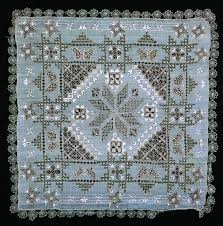
Paris — The Republic of Western Armenia has officially submitted an appeal to UNESCO, demanding a review and correction of the inclusion of embroidery registered under the name “Antep İşi” in the Representative List of the Intangible Cultural Heritage of Humanity. The initiative seeks to challenge an assessment considered historically incomplete and legally problematic, as this textile craft is presented as exclusively Turkish cultural heritage.
Hereditary Embroidery at the Center of a Cultural Dispute
In 2025, the “Antep İşi, drawn-thread embroidery of Gaziantep” technique was inscribed on UNESCO’s list as an element of Turkish intangible cultural heritage. However, according to the Republic of Western Armenia, this embroidery is historically linked to the Armenian communities of Antep, a city located in historical Western Armenia and currently known as Gaziantep.
Ethnographic studies, missionary archives, academic publications, and museum collections attest that this form of drawn-thread embroidery was widely practiced by Armenian women, particularly in domestic and religious contexts and in the preparation of dowries, long before the establishment of the modern Turkish state.
Interruption of Transmission Due to Historical Violence
The appeal submitted to UNESCO emphasizes that the disappearance of local transmission of this embroidery was not the result of cultural abandonment, but rather a consequence of the destruction and forced displacement of Armenian communities during the genocide committed against Armenians carried out between 1894 and 1923.
The accompanying legal memorandum states that intangible cultural heritage cannot be separated from the communities that bear it and cannot be exclusively attributed to a state that has, in fact, benefited from the forced disappearance of those communities.
Argumentation Based on International Law
The appeal is grounded in several international legal instruments, including:
– UNESCO’s 2003 Convention for the Safeguarding of the Intangible Cultural Heritage, which requires the clear identification of heritage-bearing communities,
– the 2007 United Nations Declaration on the Rights of Indigenous Peoples, which recognizes the right of indigenous peoples to protect and control their intangible cultural heritage,
– general principles of international law prohibiting the derivation of benefit from the consequences of an international crime.
A special legal annex dedicated to indigenous peoples’ rights is attached to the appeal, in which the Armenian people of Western Armenia are characterized as an indigenous people in the operational sense of international law, emphasizing that the forced elimination of the community does not extinguish its cultural rights.
What the Republic of Western Armenia Demands
The appeal submitted to UNESCO calls for:
– a review of the registration of “Antep İşi,”
– correction of the official description to clearly acknowledge the origin and contribution of the historical Armenian communities of Antep,
– or, alternatively, the initiation of a joint registration or recognition of multi-origin heritage, a practice already applied by UNESCO for shared or historically complex cultural elements.
A Broader Issue of Cultural Justice
Beyond the specific case of Antep embroidery, this initiative raises a broader question concerning the role of international organizations in protecting the intangible cultural heritage of peoples who have been victims of genocide or forced displacement and in preventing cultural erasure.
“This is not about disputing the contemporary use of the embroidery, but about rejecting the presentation of Armenian cultural heritage as exclusively Turkish, stripped of any historical context,” the memorandum submitted to UNESCO emphasizes.
The organization has not yet issued a public response to the appeal. According to its procedures, the Secretariat of the 2003 Convention is expected to confirm receipt of the application in the coming months and determine the subsequent course of action.